|
Complementary information can be found at the
NASA Ames Laboratory
Astrophysics Optical
Constant Facility for Solid Samples
pages.
Overview
The NASA Ames Optical Constants Facility (OCF)
was recently developed to characterize the
spectral properties of non-homogeneous refractory
solid samples, using transmission and reflection
measurements, and determine their optical
constants, from the near ultraviolet (NUV) to far
infrared (FIR).
Optical constants are the real and imaginary
parts of the complex refractive index,
respectively n and k, of a
material: N = n + ik. They describe how a
material interacts with incident light, including
transmission, reflection, refraction, absorption,
and scattering. Both real and imaginary indices
vary with wavelength.
Optical constants are fundamental input
parameters for models (e.g., radiative transfer,
atmospheric, and reflectance spectral models)
used to interpret observational data returned
from space missions and ground-based
observatories. They thus support strategic
research activities recommended by the "Origins,
Worlds and Life" Planetary Science and
Astrobiology Decadal Survey 2023–2032.
Laboratory Equipment
The OCF is composed of a Filmetrics-KLA F40-UVX
reflectance microscope, a Thermo Fisher iS50
Fourier-transform Infrared (FTIR) spectrometer,
and two Harrick Scientific variable angle
transmission (VATA) and reflection (SEAGULL)
accessories.
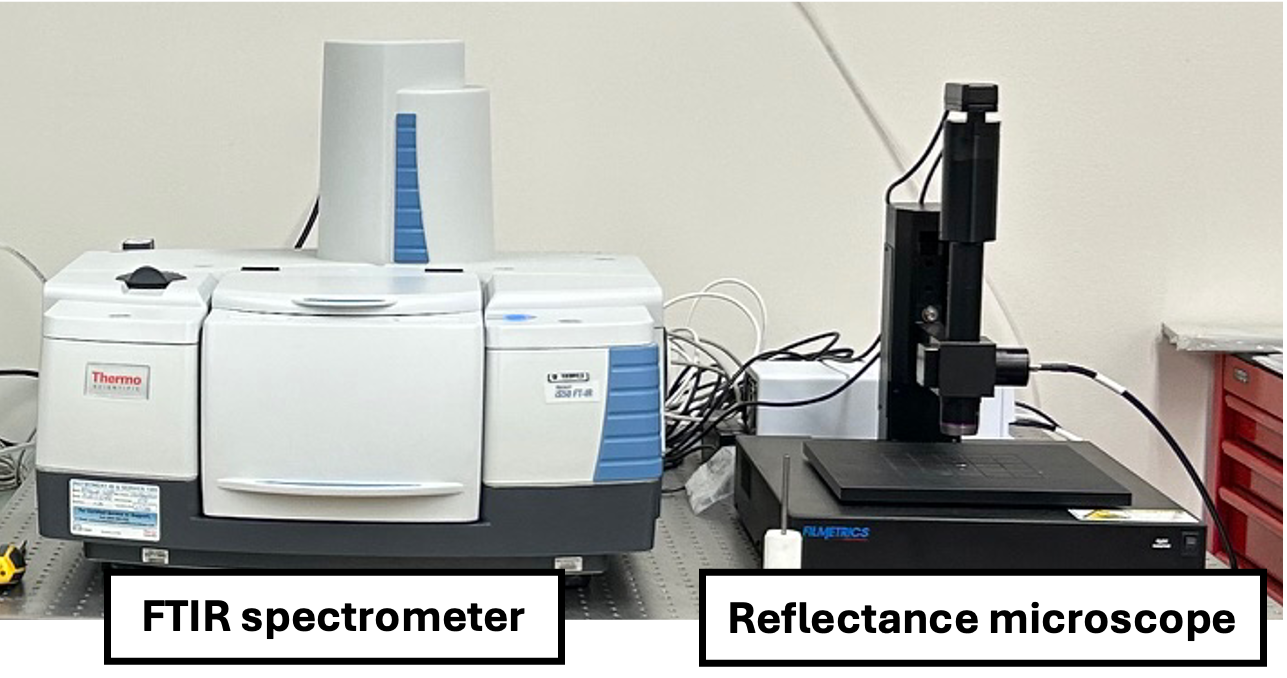
Figure 1: OCF Equipment.
Figure 1: The reflectance microscope allows
characterization of the optical properties of
samples deposited on single-polished silicon
(Si) substrates from 200 nm to 1.7 μm. This
instrument is equipped with a x10 objective,
and different apertures (50, 100, 250, and
500 μm) that allow conducting measurements
on spots as small as 5 μm diameter, hence
enabling the characterization of spectral
properties of both homogeneous and
inhomogeneous samples.
The Fourier-Transform InfraRed (FTIR)
spectrometer allows characterization of the
spectral properties of samples deposited on
different types of substrates (e.g., magnesium
fluoride MgF2, cesium iodide CsI, potassium
bromide KBr, double-polished silicon, Si) from
0.6 to 200 μm (17,000—50
cm-1). This wide wavelength range is
made possible by the availability of four
different detectors [Si (visible, Vis),
TEC-InGaAs (near infrared, NIR), DLaTGS-KBr (mid-
infrared, MIR), DLaTGS-Polyethylene (far
infrared, FIR)] and four different beamsplitters
[Quartz (Vis), CaF2 (NIR), KBr (MIR),
Solid Substrate (FIR)]. An automated exchanger
allows full spectral coverage without breaking
purge. The spectra can be measured with a
resolution as low as 0.5 cm-1.
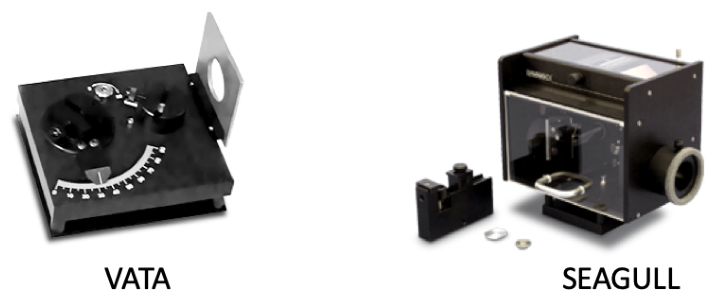
Figure 2: OCF accessories.
The Variable Angle Transmission Accessory
(VATA) and the SEAGULL variable angle
reflectance accessory can be coupled to the
FTIR spectrometer. They allow the
characterization of the optical properties of
solid samples, over a broad range of incidence
and emittance angles, from 0° to 90° for
the VATA accessory, and from 5° to 85°
for the SEAGULL accessory. The VATA and SEAGULL
accessories enable the characterization of the
angular light distribution in both transmission
and reflection measurements.
Optical Constants Determination
Inversion codes using the Cauchy equation,
Swanepoel method, and subtractive Kramers–Kronig
relations have been developed to determine the
thickness and both n and k indices by fitting
interference fringes observed in spectral
measurements.
By combining optical constants determined from
reflection measurements in the NUV-NIR range and
from transmission measurements in the Vis-FIR
range, the OCF provides refractive indices of
refractory solid samples over a wide wavelength
range. Below are examples of optical constants of
analogs produced with the COSmIC and determined
with OCF:
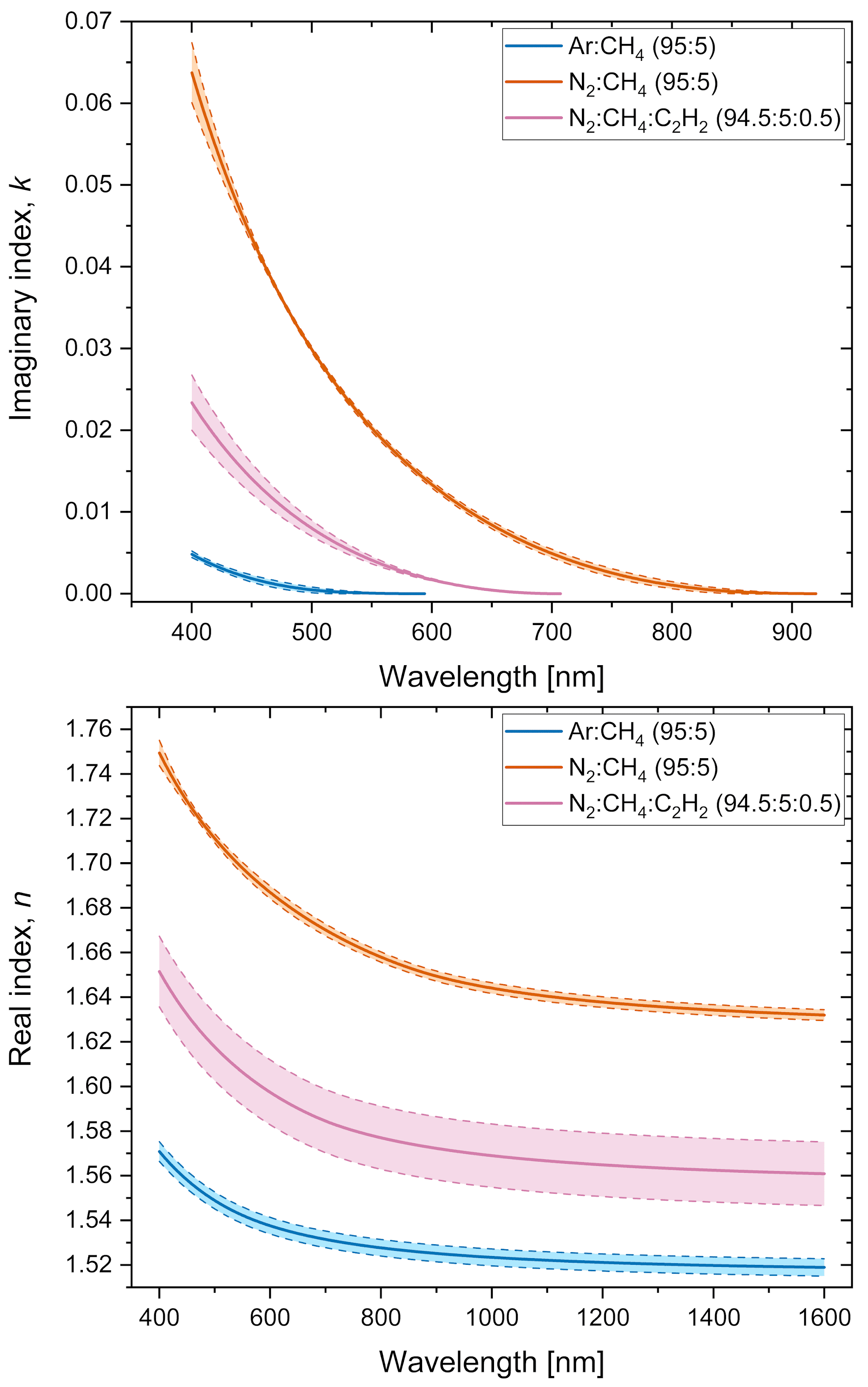
Figure 3: Optical constants n and
k determined for aerosol analogs
produced by plasma chemistry in
Ar:CH4,
N2:CH4, and
N2:CH4:C2H2
gas mixtures (adapted from Sciamma-O'Brien
et al. 2023). This comparison shows that
higher nitrogen content in the solid samples
(from elemental composition determined by Nuevo
et al. 2022) results in higher n
and k.
Example of Planetary Application: Titan
The optical constants of COSmIC
N2:CH4 aerosol analogs
shown above were used in a radiative transfer
model to interpret Cassini VIMS (Visible and
Infrared Mapping Spectrometer) observations of
Titan (T-79 flyby).
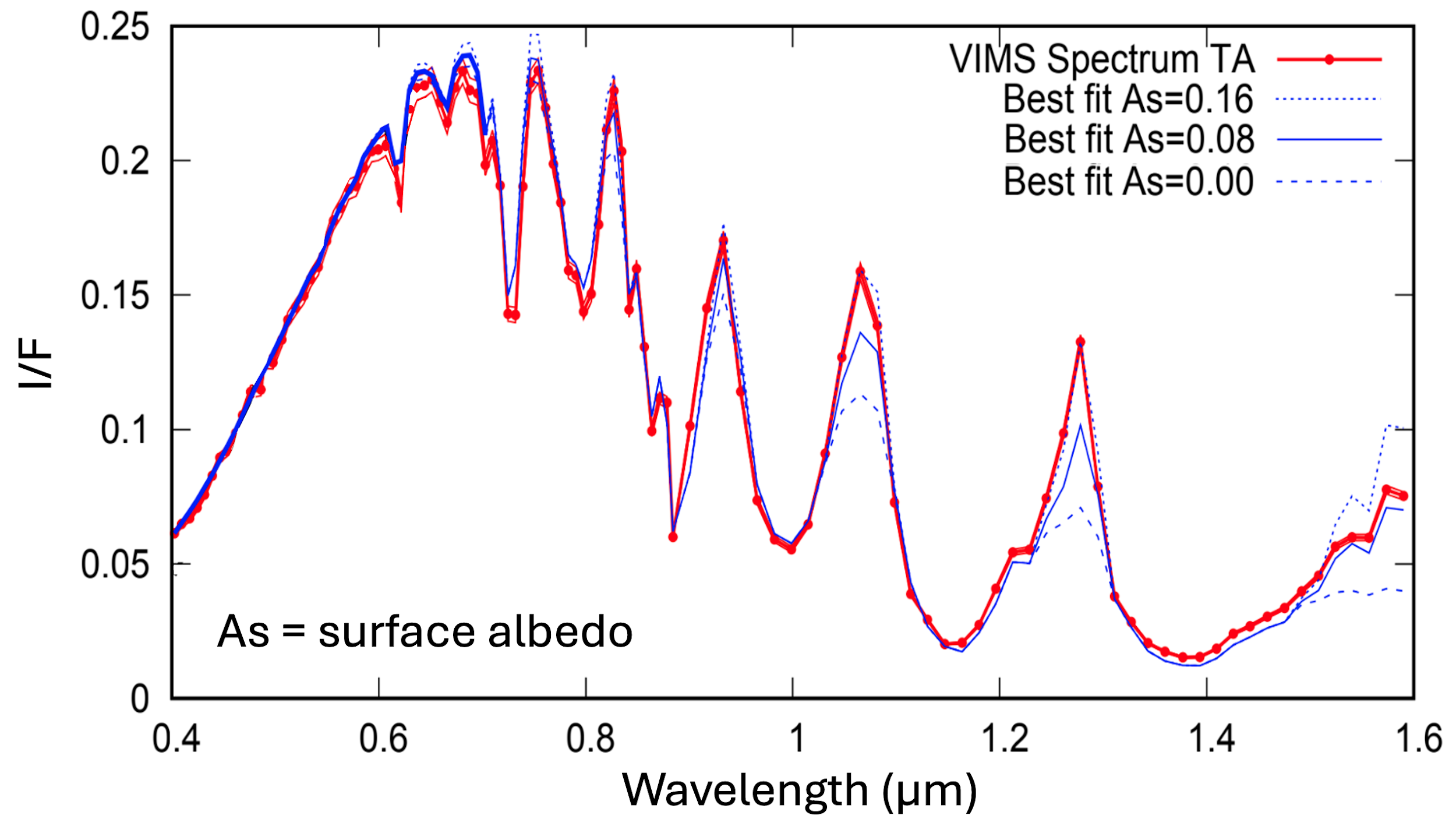
Figure 4: Radiance factor observed with VIMS
between 0.4 and 1.6 μm during the T-79 flyby
(in red) compared to best fits calculated with
optical constants determined for Titan aerosol
analogs produced with the COSmIC facility,
considering different surface albedos As
(adapted from Sciamma-O'Brien
et al. 2023).
The analysis of Cassini VIMS observations showed
that aerosol analogs, which contain more nitrogen
and are more absorbing, have a spectral behavior
that is more representative of Titan's aerosols.
Optical Constants Database (OCdb)
The NASA Ames Optical Constants database (OCdb)
was launched in January 2023. It is a data
repository developed to provide published,
peer-reviewed optical constants of organic
refractory materials and ices relevant to
(exo)planetary and astrophysical environments.

Figure 5: OCdb Logo.
The goal of OCdb is to centralize published
optical constants data to facilitate both their
access by the scientific community and the
analysis and interpretation of observational
data returned by ground- and space-based
telescopes and space missions. Laboratories
generating optical constants are encouraged to
contribute their data in order to increase their
visibility and availability.
For now, the Optical Constants database provides
data sets for ice samples (pure and mixtures),
and organic refractory materials produced from
irradiation of ice samples (also called "ice
tholins" or "ice residues") or gas precursors
(also called "gas tholins"). We plan to expand
the types of materials in the future.
|